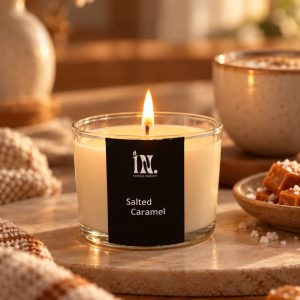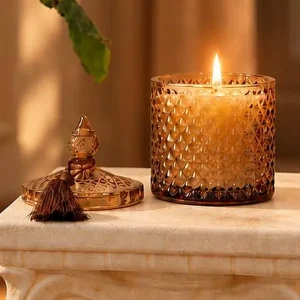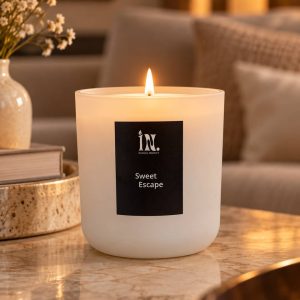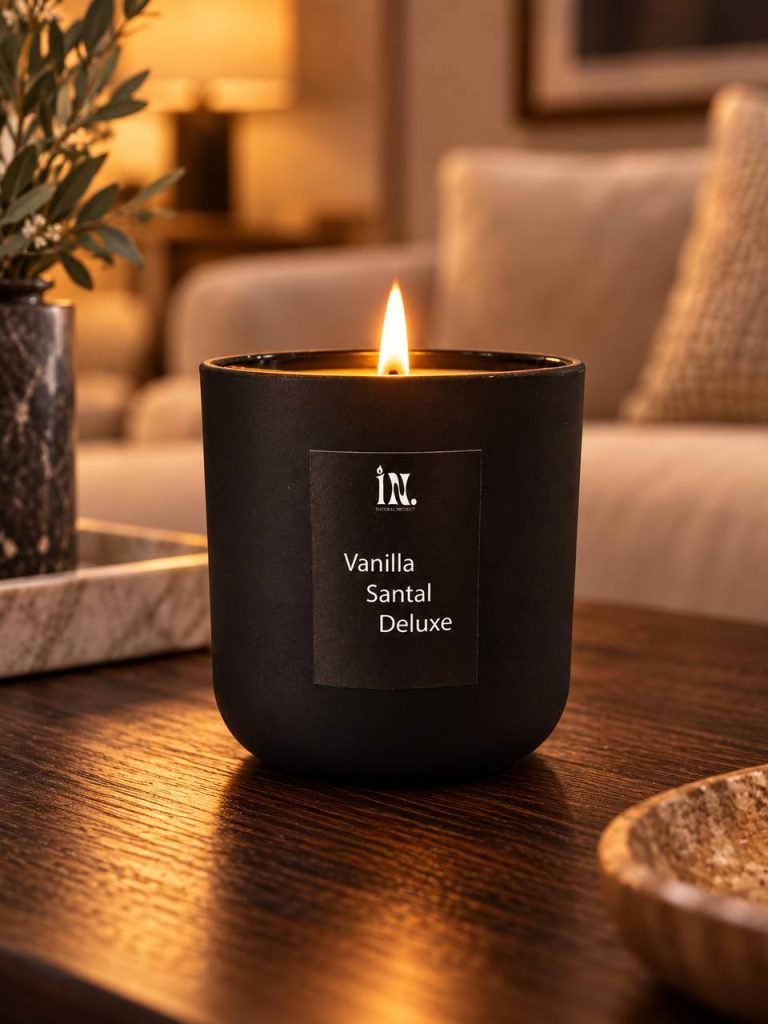
When choosing a scented candle, most of us look at the scent and the glass. Yet the real engine of a candle is its wax: it decides how evenly the candle melts, how strongly the scent comes through, lit or unlit, and how the surface looks. In this article we compare the most common candle waxes and explain why IN.candles candles and sachets are made with a plant-based coconut wax blend.
- Waxes differ in origin, hardness and melting point — and that shapes both the burn and the scent.
- Pure coconut wax is very soft, so candles use coconut wax blends.
- Our wax: coconut wax, coconut oil and vegetable fats — no paraffin, soy or palm wax.
- Soot depends mostly on the wick and how you burn the candle, not on the type of wax.
How a candle actually works
A candle does not burn its wick — it burns wax. The heat of the flame melts the wax around the wick, the liquid wax travels up the wick, vaporises and burns. The fragrance oil is blended into the wax and evaporates along with it, which is why you smell a candle best once an even layer of liquid wax — the melt pool — has formed on top.
- 1Flame — melts the wax and vaporises it
- 2Melt pool — liquid wax that releases the scent into the room
- 3Wick — draws the melted wax up to the flame
- 4Solid wax — holds the fragrance and gives the cold throw
- 5Hot throw — the scent of a burning candle
Candle scent has two sides. The cold throw is what you smell from an unlit candle, and the hot throw is the scent released from the melt pool of a burning one. The wax affects both: how easily it melts, how well it holds the fragrance oil and how evenly it lets it go.
The most common candle waxes
Here are the six waxes you are most likely to come across. The descriptions are general — every manufacturer’s blend is a little different.
Paraffin
From petroleumA by-product of oil refining and the most widely used candle wax in the world. Cheap, easy to mould and strongly scented. Many buyers avoid it because of its fossil origin.
Soy wax
Plant-basedMade from hydrogenated soybean oil. Soft and creamy, it melts at a low temperature and suits container candles. White crystals — so-called frosting — often appear on the surface.
Beeswax
Animal-derivedWax made by bees, with a natural honey scent. Hard, with a high melting point, and slow-burning. Its own scent is strong, so added fragrances come through less clearly.
Rapeseed wax
Plant-basedMade from hydrogenated oil of rapeseed grown in Europe. Creamy and soft, similar to soy wax and often blended with other waxes.
Palm wax
Plant-basedA hard wax from palm oil, often used for pillar candles with a crystal pattern. Palm oil production is linked to rainforest clearing, so many makers — including us — do not use it.
Coconut wax
Plant-based · our choiceA white, very soft wax made from hydrogenated coconut oil. On its own it is too soft for a candle, so it is blended with other vegetable fats. In a blend it gives a creamy, smooth surface, an even melt and a good scent throw.
A side-by-side comparison
The melting point tells you a lot: the lower it is, the faster a melt pool forms and the softer the wax. A very low melting point, though, means the wax will not keep its shape in a warm room — which is why coconut wax is always blended.
- Coconut wax (pure)35–40 °C
- Rapeseed wax45–55 °C
- Soy wax46–54 °C
- Paraffin46–68 °C
- Palm wax55–62 °C
- Beeswax62–64 °C
| Wax | Origin | Texture | Scent throw | Price |
|---|---|---|---|---|
| Paraffin | petroleum | hard, smooth | low | |
| Soy wax | soybean oil | soft, creamy | medium | |
| Beeswax | bees | hard | own honey scent | high |
| Rapeseed wax | rapeseed oil | soft, creamy | medium | |
| Palm wax | palm oil | hard, crystalline | medium | |
| Coconut wax blend | coconut oil and vegetable fats | creamy, smooth | higher |
The ratings are general and based on typical blends. Scent throw also depends on the fragrance oil, how much of it is used, the wick and the room.
Our wax: a plant-based coconut wax blend
For IN.candles candles we use a professional coconut wax blend for container candles — made specifically for candles poured into glass. According to the manufacturer’s safety data sheet, it contains:
The wax melts at around 55 °C and is poured at around 60 °C. A low pouring temperature means the fragrance oil goes into relatively cool wax. According to the manufacturer, the wax is GM-free and contains no animal-derived ingredients.
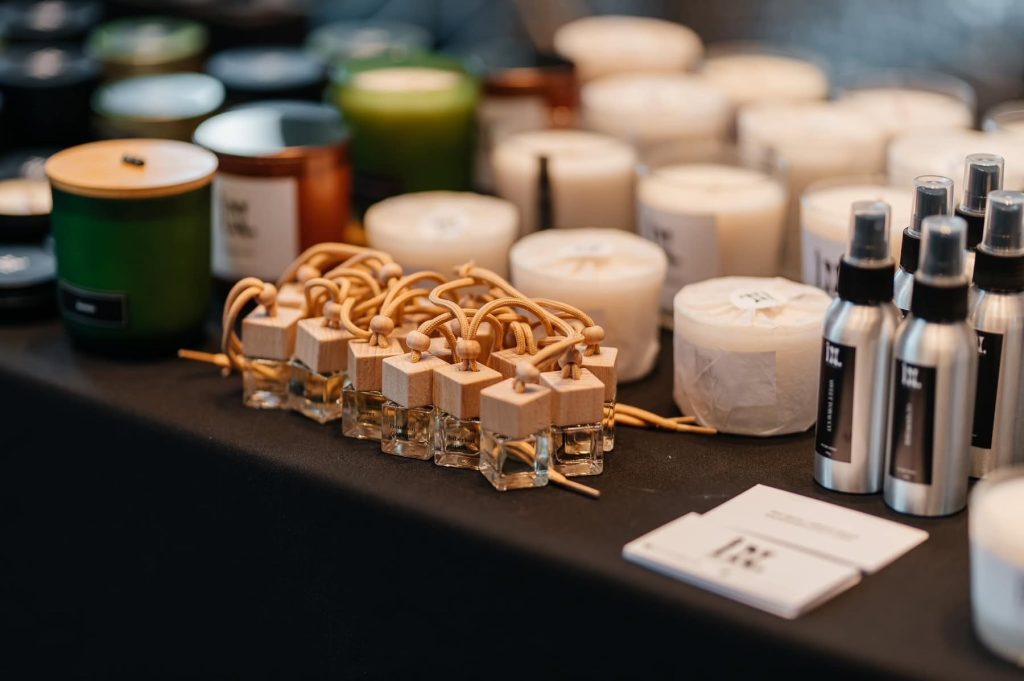
You may have seen labels saying “100% coconut wax”. Pure coconut wax is so soft and melts at such a low temperature that it cannot make a proper candle, which is why coconut candles are practically always blends. We say it as it is: a plant-based coconut wax blend. If a maker promises pure coconut wax, it is worth asking for the exact composition.
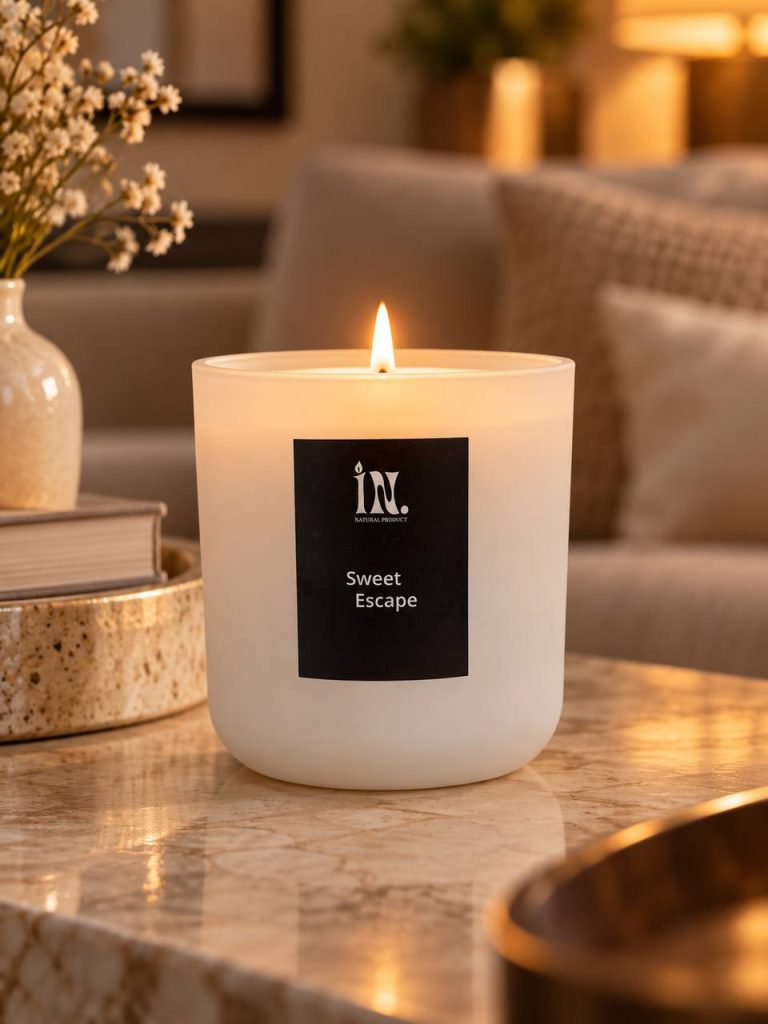
Why a coconut wax blend in a candle?
Why a coconut wax blend in a sachet?
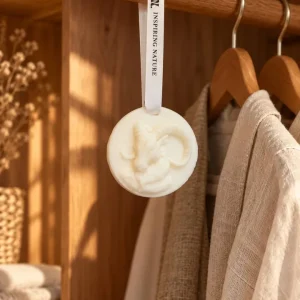
A scented sachet is a wax tablet or figurine that is never lit. The scent is released from the surface of the wax at room temperature — just like the cold throw of an unlit candle. That is why a sachet needs a wax that holds fragrance well and releases it for a long time.


- Scent without a flame. A softer coconut wax blend releases scent at room temperature better than a very hard wax.
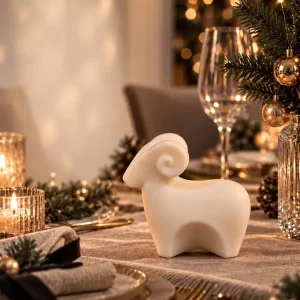
- Holds detail. The blend can be poured into detailed figurines and reliefs — like our ram.
- No fire, no electricity. Perfect for a wardrobe, a chest of drawers, between bed linen or in the hallway.
The wax melts at around 55 °C, so keep sachets away from direct sun, radiators and hot cars in summer. If the scent fades over time, rub the surface lightly with your fingers — a fresh layer brings the scent back.
How to get the most from a coconut candle
Even the best wax needs to be burned well. The first burn matters most: wax “remembers” its first melt pool.
✓ A proper first burnthe melt pool reaches the edge of the glass
✕ Tunnellingthe first burn was too short
- The first burn. Let the candle burn until the melted wax reaches the edge of the glass — roughly 1 hour for every 2.5 cm of diameter. This prevents tunnelling.
- Trim the wick. Before every lighting, trim the wick to about 5 mm: the flame stays calm and does not smoke.
- No longer than 4 hours. Do not burn the candle for more than 4 hours at a time.
- A safe spot. Keep the candle away from draughts, on a flat heat-resistant surface, and never leave a burning candle unattended.
- Stop in time. When about 1 cm of wax is left at the bottom, the candle has done its job. Return the empty glass and get 10% off a new candle.
You will often hear that some wax “never soots”. In reality, soot appears mainly when the wick is too long, the candle stands in a draught or the wick does not suit the container. A well-made candle that is burned correctly burns calmly whatever the wax — so instead of promising miracles, we give advice.
About our fragrance oils: we use phthalate-free fragrance oils with an IFRA certificate of conformity. Like any fragrance, they can cause an allergic reaction in sensitive people — you can try a scent on a free scent strip before you buy. See all 33 scents and their notes on the Scents page.
Frequently asked questions
Is coconut wax better than soy wax?
Neither is better at everything. A coconut wax blend usually gives a creamier surface and a good scent throw, while soy wax is cheaper and more prone to white crystals. We chose a coconut wax blend for its scent and look.
Are your candles 100% coconut wax?
No. We use a plant-based coconut wax blend (coconut wax, coconut oil and hydrogenated vegetable fats) with no paraffin, soy or palm wax. Pure coconut wax would be too soft for a candle.
Why is the surface uneven after I blow the candle out?
Plant-based wax blends can set with a slightly uneven surface after the candle is put out. This is normal and affects neither the burn nor the scent — the surface melts smooth again the next time you light it.
How long does a scented sachet last?
It depends on the scent, the temperature and the airflow: in a closed wardrobe the scent lasts longer than in an open room. When it fades, rub the surface of the sachet lightly.
Can I try a scent before buying?
Yes. On request we send free scent strips — the full set or the scents you choose. Write to us at info@inlove.ee.
Sources: the wax manufacturer’s technical data sheet and safety data sheet (coconut wax blend for container candles); properties of other waxes are general and may differ for specific blends.